
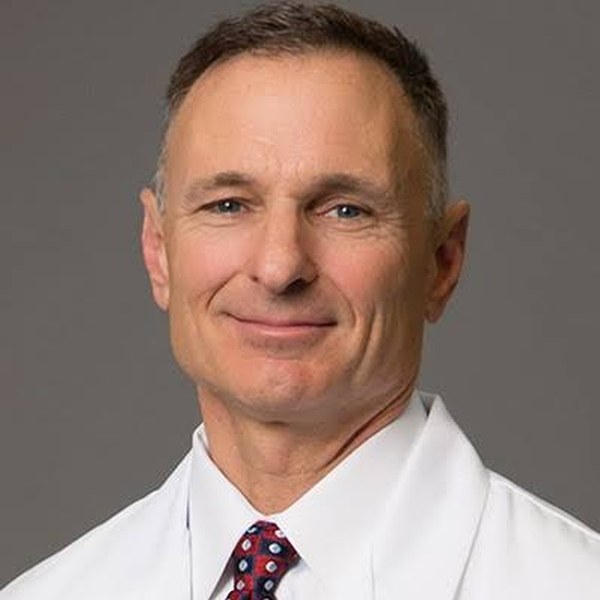
[ Dr. Kimberling ]
Pediatric Cardiology  ·  Foundation Medical Advisor since inception

Matthew T. Kimberling, M.D.

Dr. Matthew Kimberling is a board-certified pediatric cardiologist practicing in Tulsa, Oklahoma. He has guided the Chase Morris Foundation's screening program since the foundation's earliest days. He is the cardiologist whose interpretation of every ECG and echocardiogram at every foundation event has stood between a family and the unknown — and the cardiologist who has met with families on-site whenever a finding required follow-up.

Dr. Kimberling earned his medical degree from the University of Oklahoma College of Medicine in 1994, completed his pediatrics residency and pediatric cardiology fellowship at Washington University in St. Louis (Barnes-Jewish / St. Louis Children's Hospital, 1994–2000), and joined Pediatric Cardiology of Oklahoma in 2000. He has served as past President of the American Heart Association, Tulsa Chapter. He holds faculty appointments as Clinical Associate Professor of Pediatric Cardiology at the OU College of Medicine in Tulsa and Clinical Assistant Professor of Pediatrics at the OSU College of Osteopathic Medicine. He is currently affiliated with Ascension St. John Medical Center.

Dr. Kimberling is also an alumnus of Metro Christian Academy — the Tulsa private school where the Chase Morris Foundation held its first heart screening in the fall of 2014. He returned to his own high school to apply the international screening protocol he had spent his career studying, to the next generation of Metro athletes.

Board certified, Pediatric Cardiology  ·  American Board of Medical Specialties  ·  M.D., University of Oklahoma College of Medicine, 1994  ·  Fellowship, Washington University, 2000  ·  Past President, American Heart Association, Tulsa Chapter
[ Dr. Cavanagh ]
Sports & Family Medicine  ·  Foundation Screening Physician

LaMont E. Cavanagh, M.D.

Dr. LaMont Cavanagh is a Tulsa native and a board-certified sports medicine and family medicine physician at OU Health Physicians, where he serves as Chair of the Department of Family & Community Medicine within the OU-TU School of Community Medicine. He has supported the Chase Morris Foundation's screening program from its earliest days, lending his expertise in pre-participation athletic evaluation to the foundation's events alongside Dr. Kimberling.

Dr. Cavanagh earned his undergraduate and medical degrees from the University of Oklahoma. He served five years as an Air Force flight surgeon and remains chief of aerospace medicine for the 138th Fighter Wing of the Oklahoma Air National Guard. He completed family medicine residency and sports medicine fellowship at the OU College of Medicine in Tulsa in 2000 and joined the clinical faculty in 2001.

His clinical responsibilities include serving as Medical Director for the OU Physicians Health@Work program, the Sports Medicine Fellowship program, the Center for Exercise and Sports Medicine, and the Center for Sport Concussion. He has served as team physician at the professional, collegiate, and high school levels and is medical director for the Route 66 Marathon. Dr. Cavanagh has consistently ranked among Oklahoma's top sports medicine physicians and is affiliated with Ascension St. John Medical Center and Hillcrest Medical Center.

Board certified, Family Medicine and Sports Medicine  ·  Chair, Department of Family & Community Medicine, OU-TU School of Community Medicine  ·  M.D., University of Oklahoma College of Medicine, 1992  ·  Fellowship, Sports Medicine, OU College of Medicine, Tulsa, 2001
A national authority

The science behind the protocol.


The screening protocol the Chase Morris Foundation has applied at every event since 2014 is built on the international standard developed by an expert consensus panel led by Dr. Jonathan A. Drezner, M.D., professor of family medicine at the University of Washington, Director of the UW Medicine Center for Sports Cardiology, Editor-in-Chief of the British Journal of Sports Medicine, and team physician for the Seattle Seahawks and OL Reign. Dr. Drezner is one of the world's leading authorities on sudden cardiac arrest in athletes.

The protocol — first published in the British Journal of Sports Medicine in 2013 as the "Seattle Criteria" and updated in 2017 as the International Criteria for ECG Interpretation in Athletes — is the standard the foundation's cardiologists apply to every screening tracing. Dr. Drezner has also served as Past President of the American Medical Society for Sports Medicine and as Vice-Chair of the NFL General Medical Committee.

The Chase Morris Foundation has been associated with Dr. Drezner and his team for years through our membership in Parent Heart Watch and our long-standing relationship with the Nick of Time Foundation in Mill Creek, Washington — a sister organization founded by another grieving family, where Dr. Drezner serves as Medical Director. The Chase Morris Foundation has formally adopted the Seattle Criteria as the basis for its ECG interpretation, and our screening events have been informed by the screening model Nick of Time pioneered.

The science we follow

Drezner JA, et al. "Electrocardiographic interpretation in athletes: the 'Seattle Criteria.'" British Journal of Sports Medicine, 2013;47:122–124.   ·   Sharma S, Drezner JA, et al. "International recommendations for electrocardiographic interpretation in athletes." European Heart Journal, 2018;39:1466–1480.

Evidence base

The peer-reviewed record on which we stand.

Sudden cardiac arrest in young athletes has been the subject of intensive cardiology research over the past two decades. The conditions, the screening protocols, the survival data, and the racial and gender disparities are now extensively documented in the peer-reviewed literature. The foundation does not invent its claims; we cite the published record. Selected key citations:

  • Harmon KG, Asif IM, Klossner D, Drezner JA. "Incidence of sudden cardiac death in National Collegiate Athletic Association athletes." Circulation, 2011;123:1594–1600.
  • Drezner JA, et al. "Electrocardiographic interpretation in athletes: the 'Seattle Criteria.'" British Journal of Sports Medicine, 2013;47:122–124.
  • Sharma S, Drezner JA, et al. "International recommendations for electrocardiographic interpretation in athletes." European Heart Journal, 2018;39:1466–1480.
  • Peterson DF, et al. "Aetiology of sudden cardiac arrest and death in U.S. competitive athletes: a 2-year prospective surveillance study." British Journal of Sports Medicine, 2021;55:1196–1203.
  • Petek BJ, Drezner JA, et al. "Sudden cardiac death in National Collegiate Athletic Association athletes: a 20-year study." Circulation, 2024;149:80–90.
  • Petek BJ, Harmon KG, Drezner JA, et al. "Survival outcomes after sudden cardiac arrest in young competitive athletes from the United States." Journal of the American College of Cardiology, 2025;85:1682–1692.
Evidence base

The peer-reviewed record.

Every clinical decision in the foundation's screening protocol traces to peer-reviewed literature. Each link below resolves to PubMed, where the full citation, abstract, and (where licensed) full text are available.

Screening protocol

Incidence and survival

Recognition and emergency response

Citations independently verifiable through the National Library of Medicine's PubMed database.